
by Mallika Naguran
He is a pained man on a mission. Dr Thomas J Goreau is sickened with seeing widespread and massive destruction of coral reefs that were once resplendent underwater rainforests, a joy to fishes and fishermen alike.
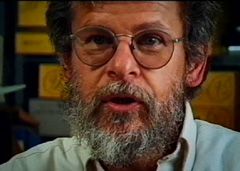
And he has no choice but to act as the value of reefs is immeasurable. “Coral reefs provide most of the marine biodiversity, fisheries, shore protection, and tourism for over 100 countries. All of this depends on having healthy corals. No other organism can do this,” says Tom.
The President of the Global Coral Reef Alliance (GCRA) is charged up to reverse the situation with a bit of help from technology. “To restore reefs we must eliminate the stresses that damage corals and use new methods to grow them faster and more resistant to stress,” he says.
Technology to Help Grow Corals
Tom has an illustrious career. He was previously Senior Scientific Affairs Officer at the United Nations Centre for Science and Technology for Development, in charge of global climate change and biodiversity issues, and has published around 200 papers in areas such as coral reef ecology, changes in global ocean circulation, tropical deforestation and reforestation and mathematical modeling of climate records.
Tom developed the method to predict the location, timing, and severity of coral bleaching from satellite data with Ray Hayes. In 1990 Tom formed GCRA, a non-profit organization for coral reef protection and sustainable management, with a network of volunteer scientists, divers, environmentalists and organizations.

Corals grow 3 to 5 times faster with Biorock.
Using technology as a means, essentially Biorock that was invented by the late Wolf Hilbertz, they address the needs of coral reef restoration, marine diseases and issues caused by global climate change, environmental stress and pollution.
The method allows reefs to survive and recover from damage caused by excessive nutrients, climate change, and physical destruction. To build a Biorock reef, a low voltage electrical current is passed through a conductive frame that’s anchored to the seabed. Power can be sourced from chargers, windmills, solar panels or tidal current generators.
The electrolytic reaction causes mineral crystals such as calcium carbonate and magnesium hydroxide found in seawater to grow on the structure. Within days, a whitish hue that is made up of precipitated minerals coat the structure’s surface – a sign that the wired frame is ready for action.
Divers then begin transplanting coral fragments from other reefs and attach them to the frame. The coral pieces begin to bond to the accreted mineral substrate immediately and start to grow at a rate up to five times faster than usual. Soon the frame with dotted corals becomes a habitat for a reef ecosystem, attracting colonizing marine life such as fish, crabs, clams, octopus, lobster, and sea urchins.
“In the Maldives during the 1998 warming, fewer than 5% of the natural reef corals survived. But on our GCRA reefs, 80% of corals not only survived, they flourished,” says Tom. Corals from these reefs are now recolonizing the surrounding natural habitats, I am told. GCRA reefs are growing vibrantly in Thailand, Indonesia, Papua New Guinea, Panama, and Mexico.
Growing Up Among Corals
Tom, growing up in Jamaica was swimming as soon as he could walk. “I have dived longer and in more reefs around the world than any coral scientist,” says Tom, previously Senior Scientific Affairs Officer at the United Nations Centre for Science and Technology for Development.
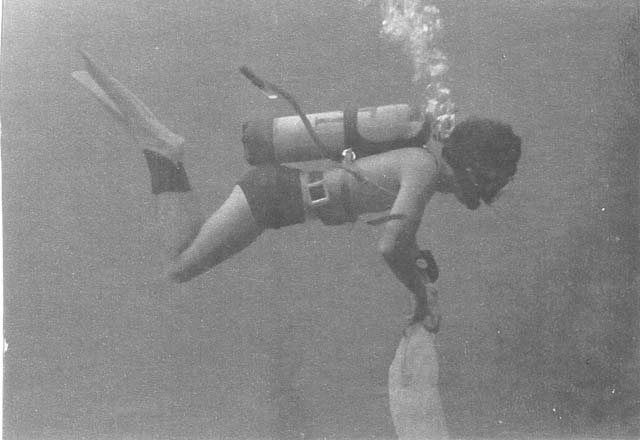
What Tom did to pass time as a boy.
Tom could very well have coral DNA in his cell structure as his father Thomas F Goreau was the first diving marine scientist, researching on coral ecology in 1948. Grandpa Fritz Goreau was notable too for pioneering underwater photography using self-made underwater cameras and breathing dive apparatus. They took the first high quality photographs of coral reef organisms in the Central Pacific, Bahamas, and the Great Barrier Reef among other locations.
“When I was young we would travel around Jamaica where my father would show his underwater photographs to fishermen and tell them why the reefs were disappearing and in danger. So it is just something I grew up doing and had the fortune of learning from the person who knew the most about coral reefs,” says Tom.
“I continue only because no one else has this background, experience and knowledge, and somebody has to maintain it,” he adds, in spite of losing parts of his hand to a barracuda attack in 2004, which has since been reconstructed.
“There is almost no place that my grandfather, father, or I knew in the past that is not heartbreakingly damaged, many so badly ruined that there is just no trace at all left of the reefs, not even rubble. Most of those who live in those areas now don't even realize what they have lost,” he frowns.
Seeing is Believing
In spite of evidence that coral reefs are thriving thanks to Biorock where they were once bleached, dead or crushed, the path chosen to save coastal reefs using this proven technology is full of rocks.
“As a career choice, it has been suicidal to be in a field where there is no funding - it is impossible to survive. I often wish I had not been obliged by circumstance to have to do this and could have had a job that I would be actually paid for.” Among the difficulties he encounters, Tom speaks about the lack of faith.
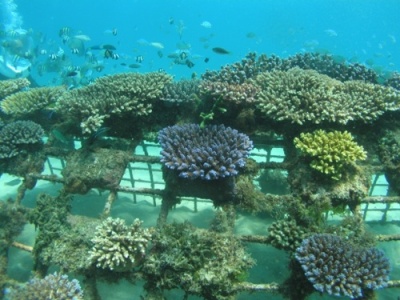
A new reef is born where once barren.
“No one believes what we do is possible until they see it themselves. Growing bright coral reefs swarming with fish in a few years in places that were barren deserts is something everybody thinks can't be done, but has been done in nearly 30 countries with only small donations, mostly from local people who remember how their reef used to be and realize they must grow more corals now,” he explains.
Describing local funding as “a drop in the bucket”, he urges the immediate resources from other sources. “Until governments, big international funding agencies, the private sector, and big international conservation groups realize that if we don't have policies and funding to restore what we have lost, it will very soon be too late.”
Photos by Tom Goreau and Club Aqua, Bali.
Tom, who is also the Coordinator of the United Nations Commission on Sustainable Development Partnership in New Technologies for Small Island Developing States, can be contacted at goreau@bestweb.net.
Visit his website at http://www.globalcoral.org